Blog / Buyer's guide
Buyer's guideCOI tracking spreadsheet, outsourced service or software: which should a GC use?
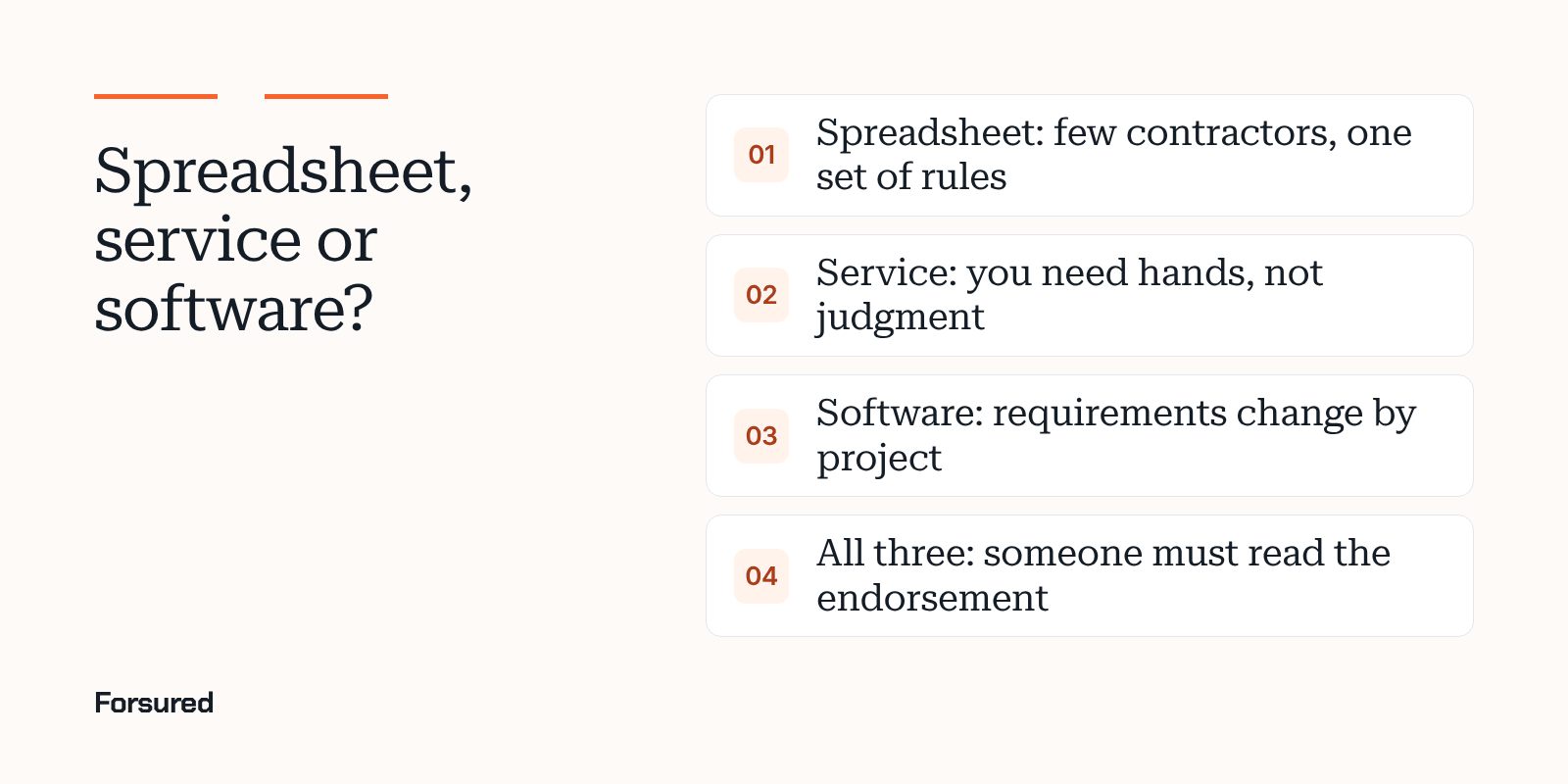
A COI tracking spreadsheet works while you have a few contractors, one set of requirements and someone who reads every endorsement. Outsource COI tracking when you need hands, not judgment. Use COI tracking software when requirements change by project, contractors work several jobs, and you want the broker fixing gaps fast.
Every general contractor manages contractor COIs one of three ways: a COI tracking spreadsheet someone on the team keeps, an outside service that collects and chases for you, or COI tracking software. Most companies start with the spreadsheet, and many never question it until a certificate that looked fine turns out not to cover them.
This guide is for owners, CFOs and project executives deciding which way to go as the subcontractor list grows. It names no vendors. It compares the three on what they catch, where they break and who ends up making the call, and it says plainly when the spreadsheet is the right answer.
Forsured makes COI tracking software, so read it knowing that. The tests below work the same whichever way you choose.
Should you manage contractor COIs in a spreadsheet, outsource COI tracking, or use software?
You should manage contractor COIs in a spreadsheet only while you have a small, stable roster, one set of requirements and a person who reads every endorsement. Outsource COI tracking when the problem is capacity. Use COI tracking software when requirements change by project and contractors work more than one job, which is most general contractors past a few dozen trades.
The choice turns on two checks that catch real gaps. The first is whether each contractor COI is checked against the requirements of the project it's for, not one master list. The second is whether someone reads the endorsement itself. An additional insured is someone who isn't automatically covered by a policy, so the endorsement, not the checkbox on the certificate, is what extends coverage to you. Any of the three approaches can do both checks. They differ in who does them, how fast, and how often they get skipped.
How do the three ways compare?
The three ways compare differently on collection, requirements, endorsements and who decides. Here's the short version.
| Job | COI tracking spreadsheet | Managed COI tracking service | COI tracking software |
|---|---|---|---|
| Collecting certificates | Your team emails and saves files | The service collects and chases | Requests and uploads go through the tool |
| Expiration dates | A formula or a calendar reminder | The service sends reminders | Automatic reminders by policy |
| Requirements by project | One row per policy, hard to split | Depends on how the service sets you up | Depends on the tool; ask to see two projects |
| Reading endorsements | A person, every time | Some services do, some don't | Some tools read the wording, some only the form |
| Getting the broker to fix a gap | Your team's email | The service's email and calls | Requests from the tool, sometimes a shared workspace |
| Who approves | Whoever keeps the sheet | Their reviewer, your sign-off | Your team, or AI on some tools |
| How cost grows | Staff hours | Per vendor, often with a minimum | Per vendor or per plan |
When is a COI tracking spreadsheet enough?
A COI tracking spreadsheet is enough when you have a short list of contractors you use again and again, your requirements barely change from job to job, and one person has the time and training to open every endorsement. In that setup the sheet is cheap, everyone knows how it works, and it holds the one thing it's built for: dates.
The problems start when any of those conditions change. Spreadsheet errors are well studied: Raymond Panko's review of the research found that spreadsheet errors are both common and non-trivial, and that cell-by-cell inspection was the one technique shown to catch them. A COI tracking spreadsheet adds a construction problem on top. It keeps one row per policy, so when two projects require different umbrella limits, the sheet can't show that a contractor passes one and fails the other. It doesn't read endorsements, so the person keeping it has to. And it doesn't notice anything. If a renewal doesn't arrive, the cell just stays the same.
Certificates also arrive wrong more often than most teams expect. IA Magazine reported that 45% to 55% of initial COI submissions are rejected for errors or missing information, according to some industry estimates. Every one of those becomes an email thread about contractor COIs that lives outside the COI tracking spreadsheet.
If you stay on a spreadsheet, keep requirements on a separate tab for each project, store the endorsement with the certificate, and have a second person spot-check approvals. Our guide to how to check a contractor COI walks through what to read on each one.
When does it make sense to outsource COI tracking?
It makes sense to outsource COI tracking when the bottleneck is hands: collecting certificates, sending reminders and chasing vendors and their brokers who don't answer. A managed COI tracking service takes that volume off your team, usually priced per vendor and often with an annual minimum.
What a service doesn't take is the risk. If a contractor turns out to be uncovered after a loss, the claim lands on your project. In one Arkansas case, a general contractor left off its contractor's policy had its own insurer pay more than $1.2 million after the Court of Appeals ruled on Mar 11, 2026 that the contractor's insurer owed nothing, Insurance Business reported. Whoever reviewed that certificate, the GC's insurer paid.
Before you outsource COI tracking, get three things in writing: what the reviewers read (certificates only, endorsements, or full policies), how your project requirements get loaded and updated, and who approves or waives a gap. Our guide to managed COI tracking services for construction lists who offers one and what each includes.
When is COI tracking software the better choice?
COI tracking software is the better choice when your projects carry their own requirements, your contractors work several jobs at once, and renewals are piling up faster than one person can track. Good software holds requirements by project, reads each contractor COI and its endorsements against them, sends the gap to the broker, and keeps watching after approval.
Not every tool does all of that. Some read endorsement wording and some only check that a form number is present, and some let AI approve on its own while others keep a person on every result. Our guide to endorsement review in COI tracking software shows the difference, and our COI tracking software checklist gives you a test for each point.
Price is rarely the deciding factor. Several tools publish free tiers or per-vendor rates, and you can see what COI tracking software costs at 50, 200 and 500 contractors before you book a demo.
Forsured checks every contractor COI against your project requirements, flags coverage gaps, brings the broker into the fix and keeps watching after approval, with a person on your team approving each result.
How do you decide for your company?
Decide by answering four questions, in this order.
- Do your requirements change by project? If yes, a single COI tracking spreadsheet will miss gaps. Use software, or a service that sets requirements up by project.
- Who reads the endorsements today? If nobody has time, either outsource COI tracking with a service that reads them, or pick software that does.
- How many contractor COIs renew each month? If renewals regularly slip, you need automatic requests and lapse tracking, which a sheet can't give you.
- Who makes the final call? Keep approvals and waivers with someone on your team, whichever way you choose.
Many general contractors land on a hybrid: COI tracking software for the work, a person who owns the decision, and a managed COI tracking service only if collection volume outgrows the team. To put numbers on the choice for finance, use our business case for COI tracking software. Our COI Journal report, spreadsheet, service or software, adds a vendor-neutral scoring method. When you're ready to compare tools, start with the best COI tracking software for construction.
Get the Forsured weekly newsletter.
One email every Monday: short summaries of the week's posts on contractor COIs and project requirements, plus the coverage gaps we're seeing on real projects.
You're on the list. Look for the newsletter on Monday.
One email a week. No spam. Unsubscribe anytime.
About Forsured
Forsured is construction insurance compliance software for general contractors and the brokers who insure their trade contractors. You set each project's insurance requirements once. Forsured reads every contractor COI and endorsement against them, flags each gap with the reason, and keeps checking through renewals until the job is done.
- Project requirements with exceptions, not one template for every job
- Endorsement review (additional insured, waiver of subrogation, primary and noncontributory), not just the certificate
- A shared workspace where the contractor's broker sees exactly what's missing
- A person on your team approves every result, with a full review history
“What stood out to us is that Forsured doesn't just organize the paperwork. It helps us understand what meets the project requirements, what needs attention, and what needs to happen next. That clarity across the GC, subcontractor, and broker is where we see the real value.”
Send us one project's requirements and a contractor COI or two. We'll show you every gap we find, free.
Common questions
Is it better to manage subcontractor COIs in a spreadsheet, outsource COI tracking, or use software?
It depends on how many contractors you track, how often requirements change by project, and who on your team can read endorsements. A spreadsheet fits a small, stable roster. A managed service fits when you're short on hands. Software fits when projects carry their own requirements and contractors work several jobs at once.
When does a COI tracking spreadsheet stop working?
It usually stops working when projects carry different requirements, when one contractor works several jobs, or when the person who keeps it leaves. A sheet holds one row per policy, so it can't show that a certificate meets one project and fails another, and nobody notices a missed renewal until someone looks.
What does a managed COI tracking service actually do?
A managed COI tracking service collects certificates, sends reminders and chases vendors and their brokers for you, and some services review endorsements and full policies. What it covers varies by vendor and plan, so get the scope in writing, including what their reviewers read and who approves or waives a gap.
Is COI tracking software worth it for a small general contractor?
It can be, because several tools publish free tiers or low per-vendor prices. The question is less the price than whether the tool holds your project requirements and reads endorsements. If it only stores certificates and dates, it does what a spreadsheet does with better reminders. Compare published prices before you book demos.
Can I use a spreadsheet and software together?
Yes, and many teams do while they switch. Keep the spreadsheet as an export or a backup, but pick one place where approvals happen so there's one answer to whether a contractor is cleared. Running two live records invites the gap you're trying to close, because nobody knows which one is right.
Does outsourcing COI tracking move the risk to the service?
Not on its own. If a contractor's coverage turns out to be missing after a loss, the claim lands on your project and your insurer, whoever reviewed the certificate. Read the service agreement for what the service is responsible for, and keep the final approval with someone on your team.
Sources
- Spreadsheet Errors: What We Know. What We Think We Can Do, Raymond R. Panko, EuSpRIG (arXiv), checked Nov 23, 2026
- Magic in a Bottle: Challenges and Opportunities with Certificates of Insurance, IA Magazine, Feb 28, 2026
- Arkansas court rules insurer owes nothing to contractor left off policy, Insurance Business, checked Nov 18, 2026
- Additional insured (AI), IRMI, checked Nov 18, 2026
We link to the original reporting and research behind every post. This post is general information, not legal or insurance advice: Forsured is a software company, not a law firm or a licensed insurance agency, so confirm anything you'll rely on with your broker or attorney. Spotted something we got wrong? Write to hello@forsured.ai and we'll fix it.
About this article
Written by the Forsured team.
Published . Every source is linked above.