Blog / How-to
How-toHow to check a contractor COI against your project requirements
A line-by-line checklist you can use on your next contractor COI, and the five places gaps hide most often.
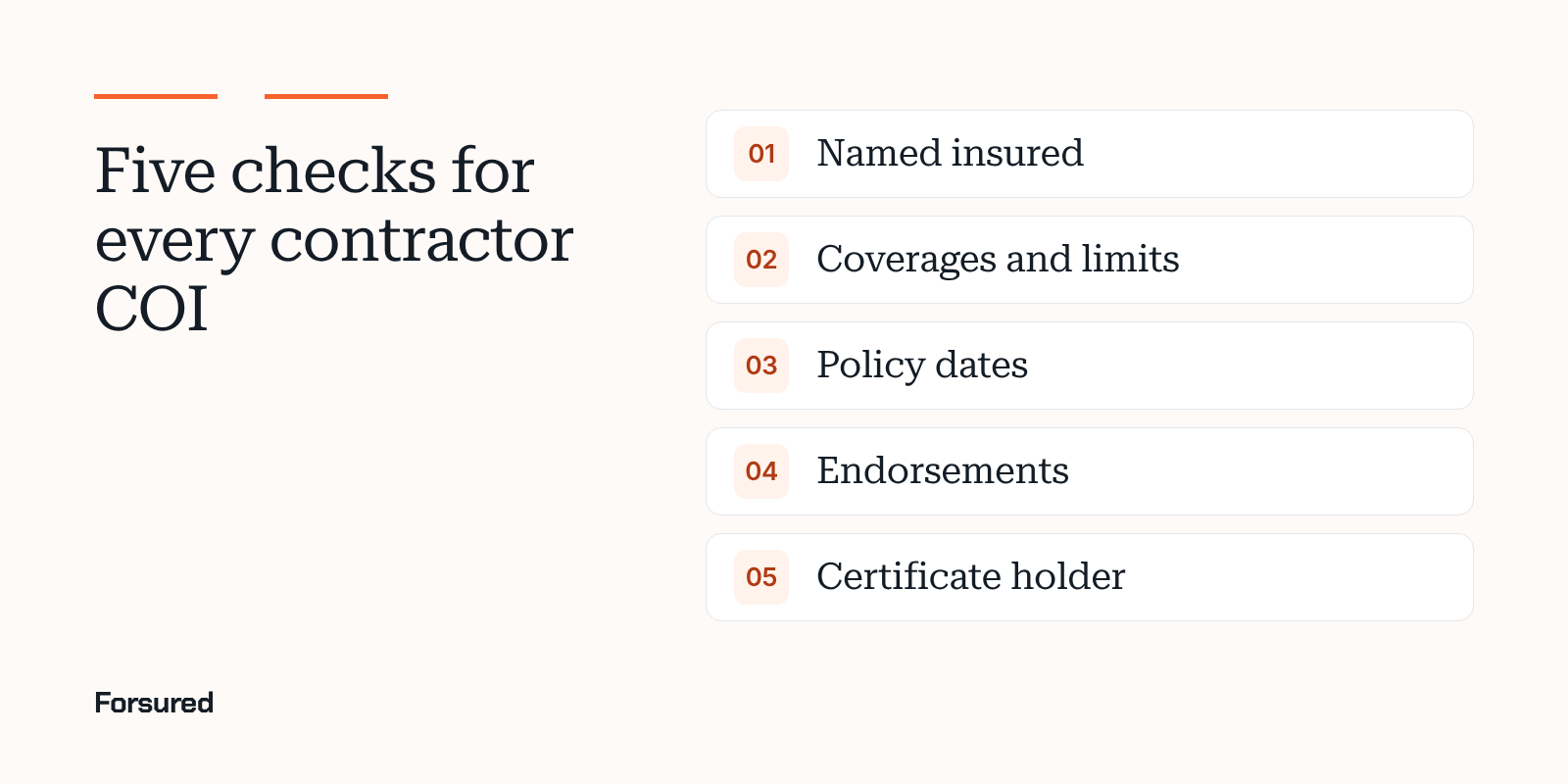
Most COI reviews fail for one reason: the certificate gets checked against a generic template instead of the requirements of the project the contractor is actually working on. Here is the checklist we use, in order.
Before you open the certificate
Pull the insurance section of the contract or the project's insurance requirements exhibit. Write down, for this project:
- Each required coverage (general liability, auto, workers' compensation and employer's liability, umbrella or excess, and anything trade-specific like professional or pollution liability)
- The minimum limit for each, including whether umbrella must follow form
- Required endorsements: additional insured (ongoing and completed operations), waiver of subrogation, primary and noncontributory
- Who must be named as additional insured: owner, lender, GC, others
- How long completed operations coverage must be maintained after the job
The five checks
1. Named insured
The named insured on the certificate should match the legal entity on the contract. A parent company, a DBA or a sister company is a gap until someone confirms the right entity is covered.
2. Coverages and limits
Compare every line against the requirements. Umbrella and excess is where shortfalls show up most, because project requirements often call for more than a trade contractor carries on its standard program.
3. Policy dates
Every policy should be in force for the work. Note each expiration date, and plan to recheck before it, not after.
4. Endorsements
A box on the certificate is not an endorsement. When the contract requires additional insured status, a waiver of subrogation or primary and noncontributory wording, ask for the endorsement forms and read them. Check that additional insured coverage includes completed operations when the contract requires it. Endorsement forms change often, so the form number matters.
5. Certificate holder and description
The certificate holder should be correct, and the description of operations should reference the project or the contract where your requirements ask for it.
When you find a gap
Send the contractor's broker the specific requirement that isn't met, quoted from the project requirements, and the line on the certificate or endorsement that falls short. Specific asks get fixed in days. Vague ones ("please send an updated COI") come back with the same certificate.
Keep it current
A COI review is only as good as its date. Recheck when a policy renews, when a certificate is reissued, and ahead of every expiration. On a long project that means continuous monitoring, which is what Forsured does for every contractor on every active project.
Get new posts by email.
New posts on contractor COIs and project requirements, plus the coverage gaps we're seeing on real projects. Short and plain.
You're on the list. Thanks for reading.
No spam. Unsubscribe from any email.
Common questions
What should I look for on a contractor's certificate of insurance?
Check that the named insured matches the contracting entity, that every required coverage is listed with limits at or above the project requirements, that the policy dates cover the work, that required endorsements are referenced and provided, and that the certificate holder is correct.
What are the most common contractor COI gaps?
The most common gaps are umbrella or excess limits below the project requirement, additional insured endorsements that leave out completed operations, policies that expire mid-project, a named insured that doesn't match the contract, and missing waiver of subrogation or primary and noncontributory wording.
Who fixes a gap on a contractor COI?
The contractor's insurance broker or agent. The fastest path is to send the broker the specific requirement that isn't met, so they can endorse the policy or issue a corrected certificate.
Sources
- Certificate of insurance (definition), IRMI
- Christopher Ruggiero to speak at the 2026 IRMI Construction Risk Conference, Cullen and Dykman
We link to the original reporting and research behind every post. Spotted something we got wrong? Write to hello@forsured.ai and we'll fix it.