Blog / COI basics
COI basicsWhat does primary and noncontributory mean on a COI?
It's one of the most common lines in construction insurance requirements, and one of the most commonly missing endorsements on a contractor's policy.
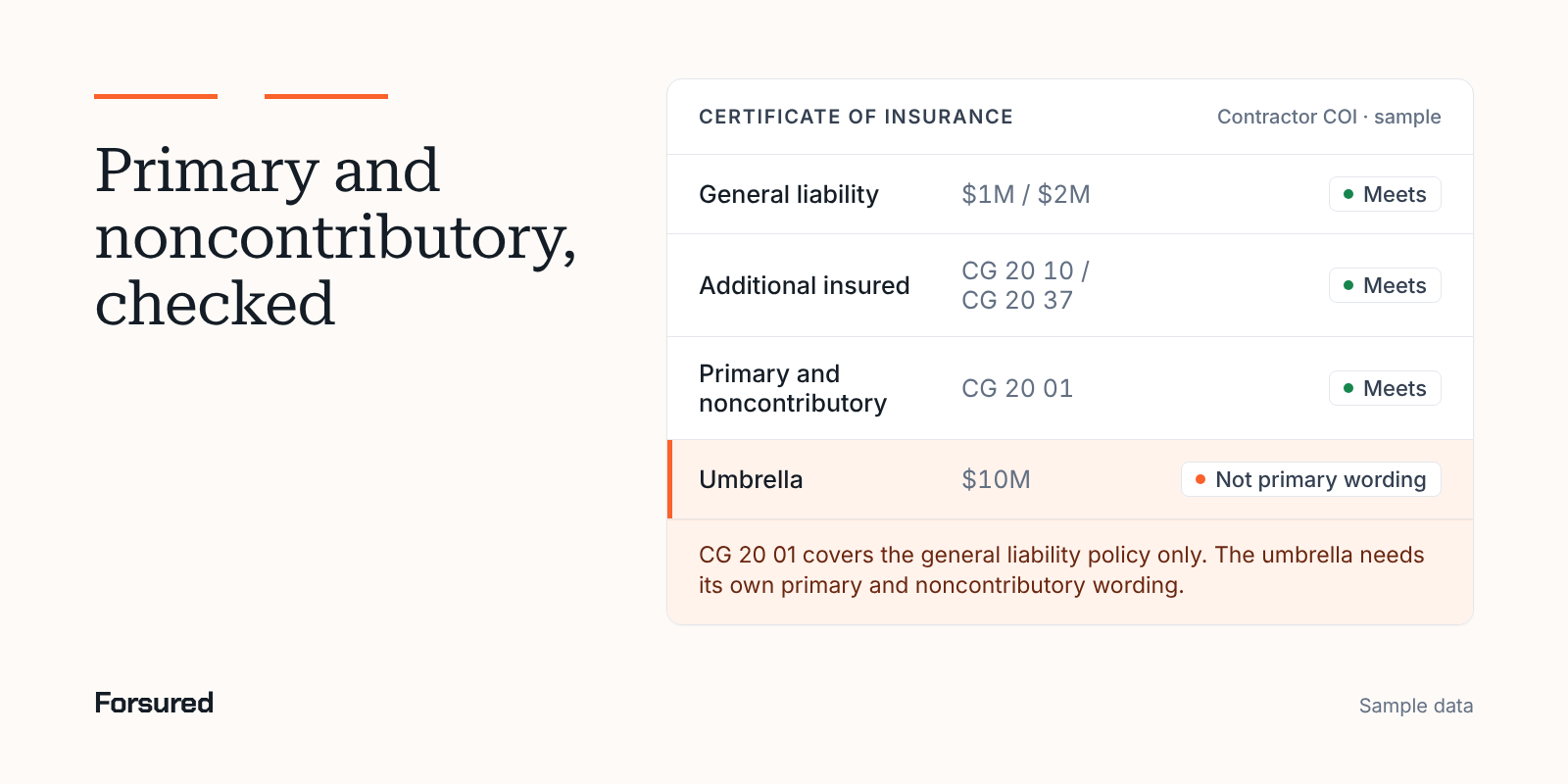
Read the insurance section of almost any construction contract and you'll find the same phrase: additional insured coverage "on a primary and noncontributory basis." It's so common it reads like boilerplate. It isn't. It decides whose insurance pays first when a contractor's work causes a loss, and whose loss history takes the hit.
What it means
IRMI describes primary and noncontributory as a term used in contract insurance requirements to set the order in which multiple policies covering the same loss respond. Split it in two:
- Primary: the contractor's policy responds first to a covered claim against the additional insured, before the additional insured's own policy.
- Noncontributory: the contractor's policy doesn't ask the additional insured's own insurance to chip in.
Without it, a general liability policy's "other insurance" condition can treat the GC's or owner's own policy as sharing the loss. That's exactly what the contract was written to avoid.
Where it comes from
Like additional insured status, primary and noncontributory is created by policy wording, not by the certificate. A checked box or a note in the description of operations on an ACORD 25 doesn't change the policy.
In 2013 ISO introduced an optional endorsement for it, CG 20 01, "Primary and Noncontributory, Other Insurance Condition." As Claims Journal explained at the time, it was added because so many construction contracts require additional insured coverage on a primary and noncontributory basis. Many carriers use it or their own version, and some blanket additional insured endorsements build similar wording in.
The fine print that trips people up
CG 20 01 comes with two conditions. It applies only when the additional insured is a named insured on another policy, and only when a written contract requires the contractor's coverage to be primary and noncontributory. Missing contract language means missing coverage.
It also amends the general liability policy only. If your project requirements call for primary and noncontributory umbrella or excess coverage, the umbrella needs to say so in its own wording. With umbrella rates still rising, it's an easy gap to miss.
What to check on a contractor COI
- Confirm the project requirements actually call for primary and noncontributory, and on which policies (general liability, auto, umbrella).
- Ask for the endorsement, not just the certificate. Note the form number and edition.
- Check that it covers the parties your requirements name: owner, lender, GC, others.
- Check the umbrella or excess policy separately when the requirements extend to it.
- Recheck at renewal. Endorsements change when policies renew, and forms keep evolving. "Evolving insurance endorsements" were the backdrop for Cullen and Dykman's session on additional insured endorsements at IRMI's 2026 Construction Risk Conference.
It's one line in the contract and one endorsement on the policy. Forsured checks both on every contractor COI, against each project's requirements, for the life of the job.
Get new posts by email.
New posts on contractor COIs and project requirements, plus the coverage gaps we're seeing on real projects. Short and plain.
You're on the list. Thanks for reading.
No spam. Unsubscribe from any email.
Common questions
What does primary and noncontributory mean?
It means the contractor's insurance responds first to a covered claim against an additional insured (primary), and does not seek to share the loss with the additional insured's own insurance (noncontributory). It protects the GC's or owner's own policy and loss history.
Is primary and noncontributory the same as additional insured?
No. Additional insured status puts you on the contractor's policy. Primary and noncontributory decides the order in which that policy and your own policy pay. Construction contracts usually require both, and each comes from its own endorsement wording.
Does CG 20 01 apply to the umbrella policy?
No. ISO's CG 20 01 amends the commercial general liability policy only. If your project requirements call for primary and noncontributory umbrella or excess coverage, check the umbrella policy's own wording.
Sources
- Primary and noncontributory (definition), IRMI
- ISO's CGL Changes for 2013, Part III, Claims Journal, Apr 9, 2013
- Christopher Ruggiero to speak at the 2026 IRMI Construction Risk Conference, Cullen and Dykman
We link to the original reporting and research behind every post. Spotted something we got wrong? Write to hello@forsured.ai and we'll fix it.