Blog / COI basics
COI basicsA COI on file isn't proof of coverage
A certificate of insurance is a snapshot. Coverage changes mid-job, endorsements decide who's actually protected, and the gap usually shows up after a loss.
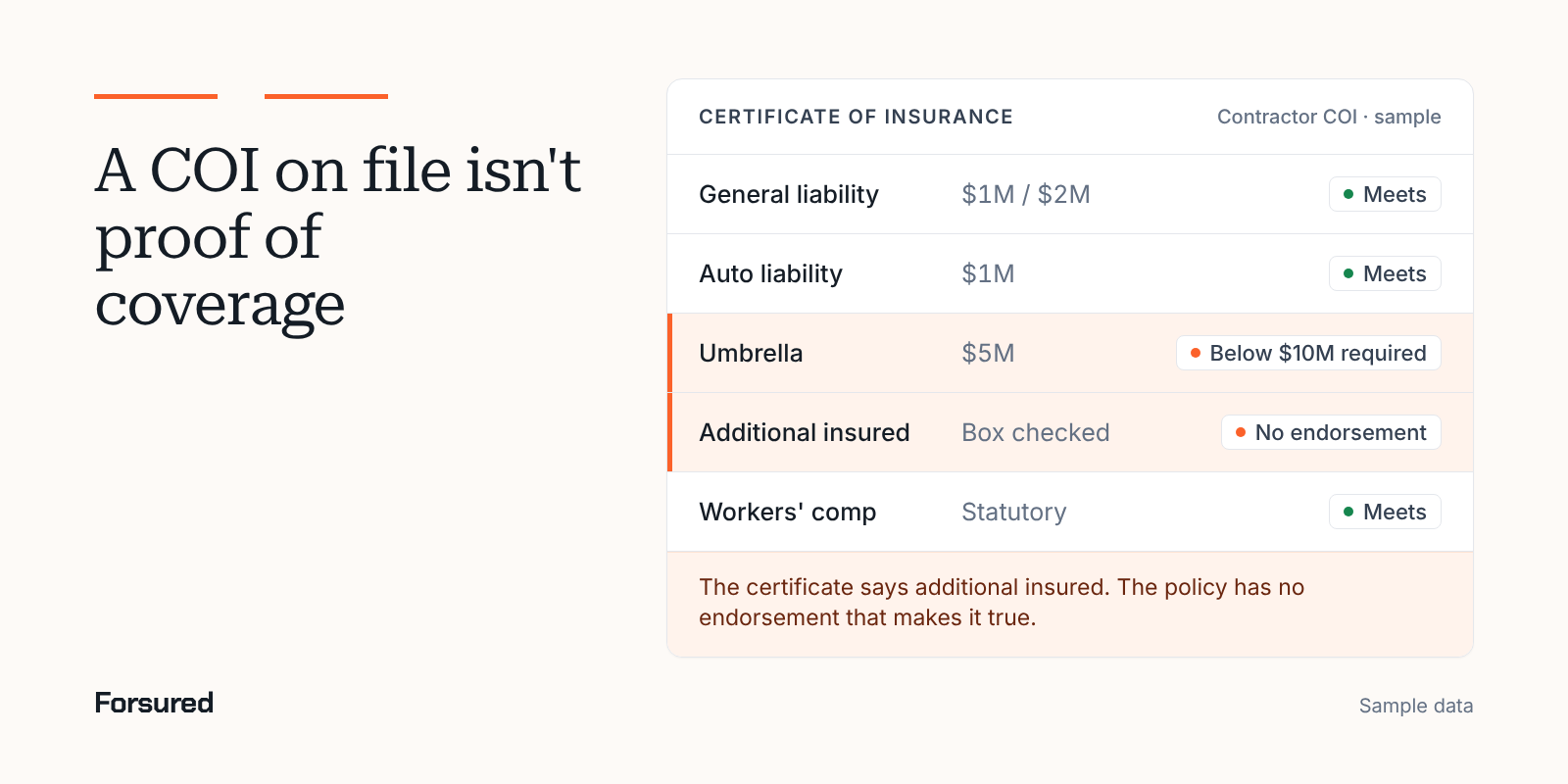
Every general contractor has a folder of contractor COIs. Most of them have been looked at once, by someone in a hurry, at the moment the contractor was onboarded. The certificate was there, the boxes were checked, and the work started.
That folder feels like protection. It usually isn't, at least not the way people assume.
What a certificate of insurance actually is
IRMI defines a certificate of insurance as a document providing evidence that certain general types of insurance have been bought, along with the types of coverage and limits. That is the whole job of the document: evidence, on the day it was issued.
The standard ACORD 25 certificate says so on its face. It is "issued as a matter of information only and confers no rights upon the certificate holder," and it does not amend, extend or alter the coverage of the policies listed. If the certificate and the policy disagree, the policy wins.
Where the gap hides
The endorsements. Additional insured status, waivers of subrogation and primary and noncontributory wording are created by endorsements on the contractor's policy. A checked "ADDL INSD" box on a certificate is not the endorsement. And endorsement forms keep changing, a point Cullen and Dykman's Christopher Ruggiero made in his session on decoding additional insured endorsements at IRMI's 2026 Construction Risk Conference: the coverage you negotiate in the contract only holds if the endorsement on the policy matches it.
The dates. Policies lapse, get cancelled for nonpayment and renew with new terms. A contractor COI that cleared prequalification in March can be out of compliance by July, and nobody finds out until there's a claim.
The limits. Project requirements often call for higher umbrella limits than a contractor carries on its standard program. With umbrella and excess rates still climbing (WTW expects another 5% to 15% in 2027), that is exactly the line where contractors trim.
The fine print in the requirements themselves. Owners and lenders write requirements that differ project to project. A certificate that satisfies one job can fail the next one across the street.
What to check instead
- Start from the project's requirements, not a generic checklist. Each project has its own limits, endorsements and wording.
- Compare every contractor COI against those requirements line by line: coverage types, limits, policy dates, and the named insured matching the contracting entity.
- Ask for the endorsements that the requirements depend on, and read the form numbers and wording, not just the box on the certificate.
- Track expirations and renewals so a policy that changes mid-project gets reviewed again.
- When something's missing, bring the contractor's broker into the fix early, while it's a paperwork problem and not a claim.
Why it matters more now
Carriers notice. WTW's 2027 construction outlook says underwriters give favorable consideration to contractors with strong management of the trade partners they hire. A file full of unchecked certificates says the opposite.
That's the work Forsured does: check each contractor COI against your project requirements, flag the gaps, and keep checking for the life of the job.
Get new posts by email.
New posts on contractor COIs and project requirements, plus the coverage gaps we're seeing on real projects. Short and plain.
You're on the list. Thanks for reading.
No spam. Unsubscribe from any email.
Common questions
Is a certificate of insurance proof of coverage?
No. A certificate of insurance is evidence that certain types of insurance were in force when it was issued. The standard ACORD 25 certificate says it is issued as a matter of information only and confers no rights on the certificate holder. Coverage is decided by the policy and its endorsements.
Does being listed on a COI make me an additional insured?
Not by itself. Additional insured status comes from an endorsement on the contractor's policy. Ask for the endorsement form and check that its wording matches what your contract requires, including ongoing and completed operations.
How often should contractor COIs be checked?
At onboarding and again whenever a policy renews, changes or is close to expiring. On a long project that means checking continuously, not once at prequalification.
Sources
- Certificate of insurance (definition), IRMI
- Christopher Ruggiero to speak at the 2026 IRMI Construction Risk Conference, Cullen and Dykman
- Insurance Marketplace Realities 2027: Construction, WTW, Oct 1, 2026
We link to the original reporting and research behind every post. Spotted something we got wrong? Write to hello@forsured.ai and we'll fix it.