Blog / Industry news
Industry newsInsurance compliance is on the trades tech map. It's filed under getting paid.
Suffolk Technologies just mapped the tools reshaping how trade contractors win, run, do and get paid for work. Insurance compliance made the map, in the last column. Where it sits says a lot about how the industry still treats it.
Suffolk Technologies just published one of the more useful pieces of construction tech writing this year: A Better Tech Stack for the Trades. Its market map sorts the tools built for trade contractors into five stages of the job. Insurance compliance is on it, in the last column, under getting paid. We think that's an honest picture of how the industry runs compliance today, and a clear sign of where the next gain is.
What Suffolk Technologies mapped
The piece starts with the labor problem. Suffolk Technologies cites estimates of a skilled-labor gap of up to 600,000 U.S. workers, and notes that for every five people leaving the industry, only two enter it. Its answer is technology "designed around the way work actually happens" in the field.
The map, titled "Enabling the next phase of jobsite execution," follows a trade contractor through five stages:
| Stage | What it covers |
|---|---|
| Win and staff work | Bidding and estimating, recruiting and training, safety and onboarding |
| Run the business | HR, payroll and crews, accounting, sales, financial intelligence |
| Plan and coordinate work | Project intelligence, field collaboration, materials and procurement |
| Do the work | Field tools and diagnostics, automation and robotics |
| Get paid and manage cash | Pay apps and billing, payment compliance, working capital |
Two arguments stand out. First, tech sprawl is real. The article says "the explosion of back-office tools is unmanageable in the long run." Second, the payoff is structural: modern tools let firms "move away from linear revenue to headcount growth." That's the right frame. The goal isn't more software. It's more work done per person, with less friction.
Where insurance compliance landed
On the map, tools for tracking certificates and prequalifying contractors sit in the payment compliance box, next to lien waivers and draw management. In other words, compliance is grouped with the paperwork that releases money.
That's accurate. On a lot of projects, the moment anyone looks hard at a contractor COI is when a payment is about to go out. If the certificate has lapsed or a requirement is missing, the payment waits until it's fixed.
The problem is timing. By the time a payment is held, the crew has already been on site, sometimes for weeks, working with the gap. If someone was hurt or something was damaged in that window, holding the check doesn't change who pays for the claim.
Move it to the start of the job
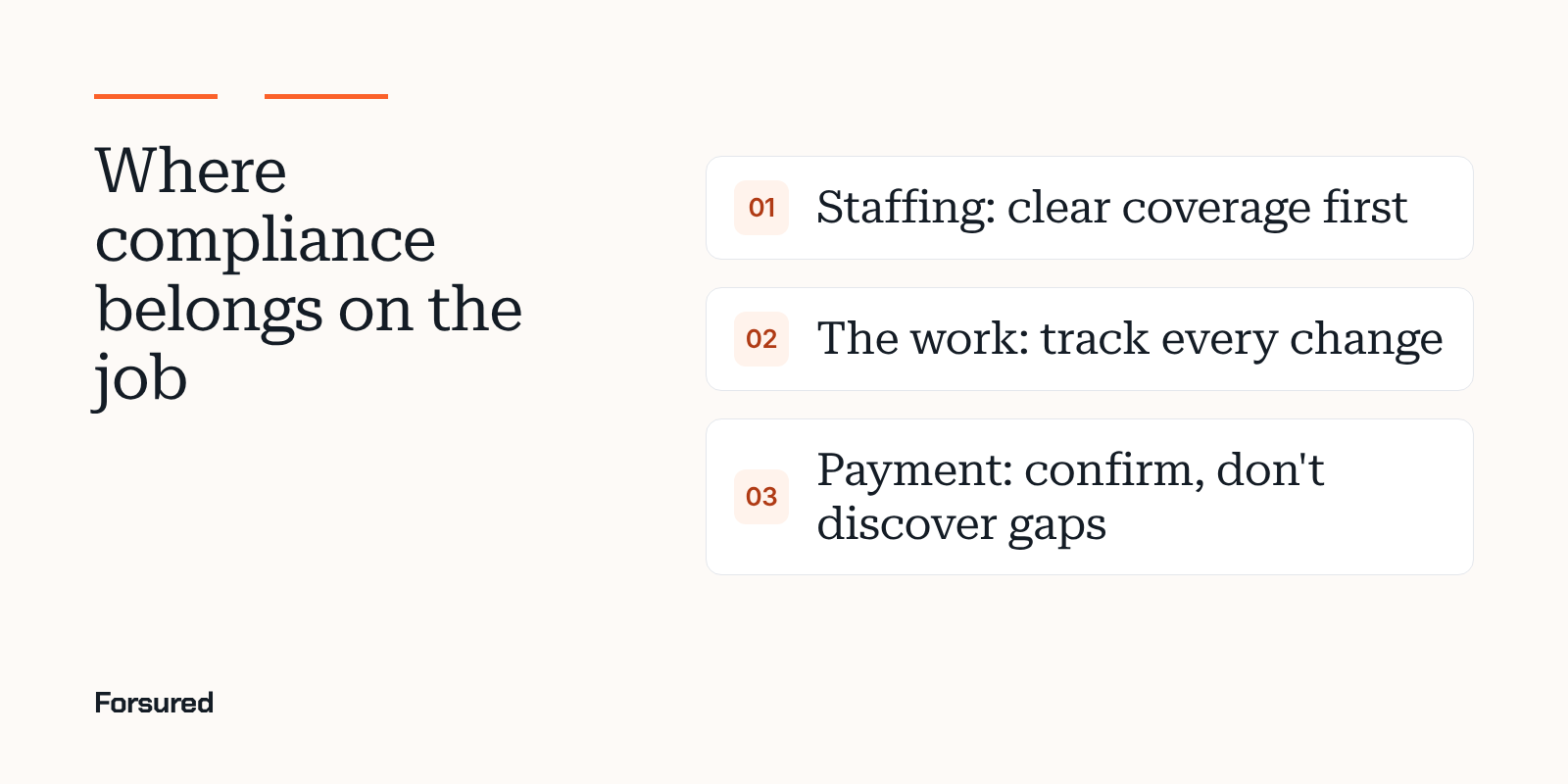
The map's first stage, win and staff work, already includes safety and onboarding. That's where insurance compliance belongs too. A contractor should prove its insurance meets the project requirements when it's staffed onto the job, before it mobilizes, the same way crews complete orientation before they start.
Then it should keep running in the do the work stage. Policies renew, change and cancel mid-project. A check that happens once at onboarding and again at each pay app misses everything in between.
Placed that way, payment becomes a confirmation, not a discovery. The pay app goes out on time because compliance was already clean.
From compliance to coverage
The second shift matters more. Most compliance work today confirms the paperwork matches a checklist: a certificate is on file, the additional insured box is checked, the limits are listed. As we've written before, compliance isn't coverage. A certificate can check every box and still leave the project exposed.
Coverage questions live in the policies and endorsements, not on the certificate:
- Does the additional insured endorsement cover completed operations, or only ongoing work?
- Is the coverage primary and noncontributory, as the project requirements say?
- Is waiver of subrogation actually endorsed, or just typed on the form?
- Do the umbrella limits sit over the right underlying policies?
Those answers decide who pays when something goes wrong. They're also the slowest part of the job to check by hand, which is exactly the kind of back-office work the article says the trades need to shed.
The bigger point
Suffolk Technologies is right that the trades deserve a better tech stack, built around the field. Its map already shows that insurance compliance is part of that stack. The next step is moving it from the end of the job to the start, and from checking paperwork to checking coverage.
That's the layer we're building at Forsured. If you want to see what it looks like on your own paperwork, send us one project's requirements and a contractor COI or two at hello@forsured.ai, and we'll run a free check.
Get new posts by email.
New posts on contractor COIs and project requirements, plus the coverage gaps we're seeing on real projects. Short and plain.
You're on the list. Thanks for reading.
No spam. Unsubscribe from any email.
About Forsured
Forsured is construction insurance compliance software for general contractors and the brokers who insure their trade contractors. You set each project's insurance requirements once. Forsured reads every contractor COI and endorsement against them, flags each gap with the reason, and keeps checking through renewals until the job is done.
- Project requirements with exceptions, not one template for every job
- Endorsement review (additional insured, waiver of subrogation, primary and noncontributory), not just the certificate
- A shared workspace where the contractor's broker sees exactly what's missing
- A person on your team approves every result, with a full review history
“What stood out to us is that Forsured doesn't just organize the paperwork. It helps us understand what meets the project requirements, what needs attention, and what needs to happen next. That clarity across the GC, subcontractor, and broker is where we see the real value.”
Send us one project's requirements and a contractor COI or two. We'll show you every gap we find, free.
Common questions
What is the Suffolk Technologies trades tech map?
It's the market map in Suffolk Technologies' article "A Better Tech Stack for the Trades" (November 2026). Titled "Enabling the next phase of jobsite execution," it sorts emerging tools for trade contractors into five stages, from winning and staffing work to getting paid and managing cash.
Where does insurance compliance appear on the map?
In the last stage, get paid and manage cash, under a category called payment compliance. Tools for certificate tracking and contractor prequalification sit there alongside lien waiver and draw management tools.
What's the difference between insurance compliance and coverage?
Compliance asks whether the paperwork matches a checklist: is there a certificate, is the box checked, are the limits listed. Coverage asks whether the policies and endorsements would actually respond to a claim on this project. A certificate can pass the first test and fail the second.
Sources
- A Better Tech Stack for the Trades, Suffolk Technologies, Nov 3, 2026
We link to the original reporting and research behind every post. This post is general information, not legal or insurance advice: Forsured is a software company, not a law firm or a licensed insurance agency, so confirm anything you'll rely on with your broker or attorney. Spotted something we got wrong? Write to hello@forsured.ai and we'll fix it.