Blog / Industry news
Industry newsDoes a project-specific liability policy cover work after the job is built?
A liability insurer doesn't have to defend the builders of a Texas toll road in lawsuits over a 130-car pileup, because the suits were about running the road, not building it.
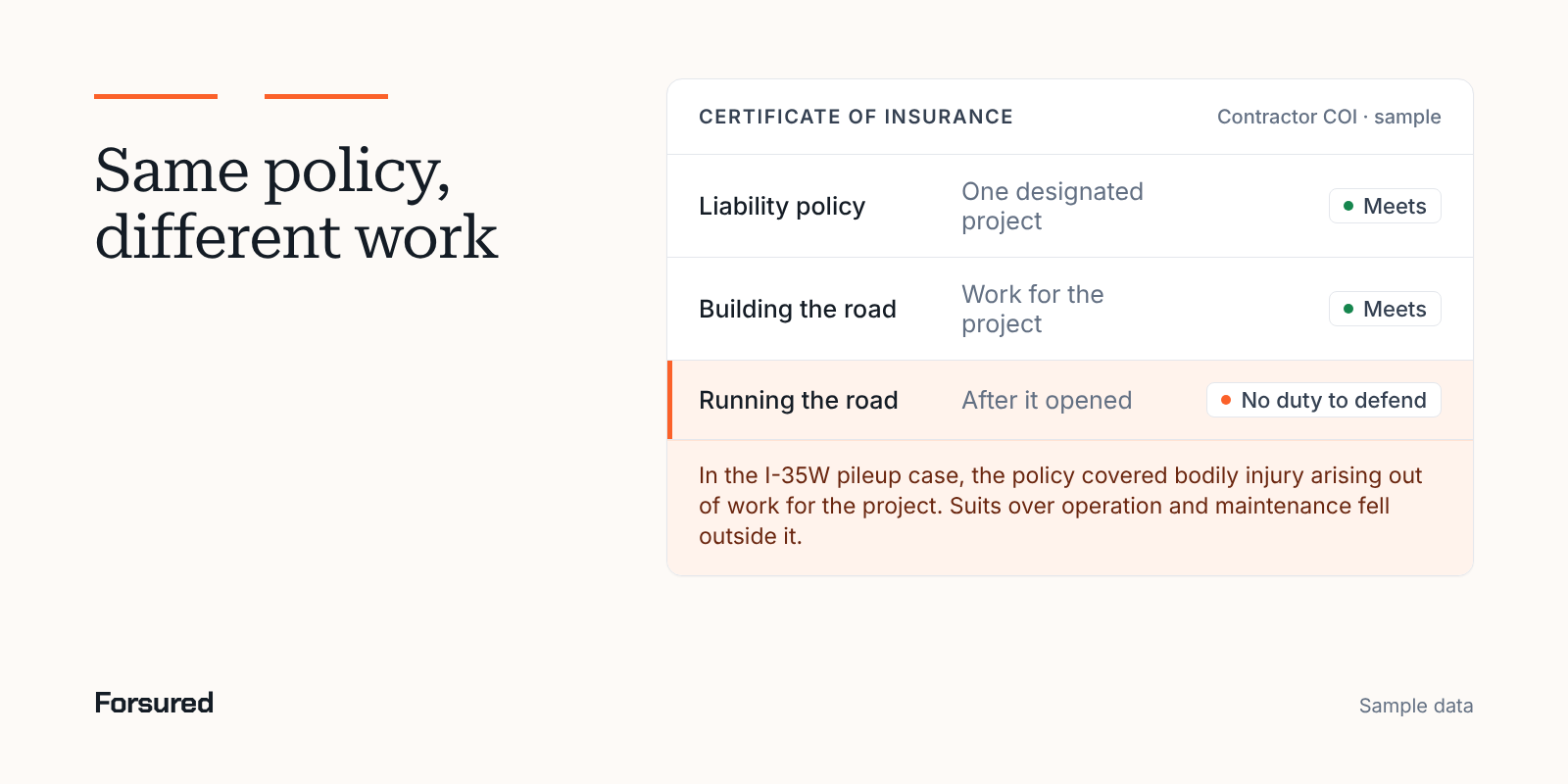
Not always. A liability policy written for one project's construction work can stop short of claims about what happens after the job is built. A Texas highway case reported last week shows how.
The pileup and the policy
On Feb. 11, 2021, a 130-car pileup in a winter storm on I-35W in Fort Worth killed six people and injured about 65, Business Insurance reports. The crash led to dozens of lawsuits against the builders of that stretch of highway, the tollway operator and trucking companies.
The builders, North Tarrant Infrastructure, Ferrovial Construction US and Webber, had a 2013 liability policy from a Liberty Mutual unit for the toll road project. The policy excluded bodily injury arising out of work for any project other than the one it named: rebuilding 6.5 miles of I-35W, building new frontage roads and adding toll lanes. In the district court's words, "the Policy only includes coverage for bodily injury arising out of work conducted for the project."
Why building it wasn't running it
Liberty Mutual defended the builders under a reservation of rights, then sued to get out of the defense. Under Texas's eight-corners rule, the duty to defend turns only on the policy and what the lawsuits allege.
The lawsuits didn't allege the road was built wrong. They alleged failures in operating and maintaining it, including preparing for winter weather. The road opened in 2018, so the district court held that later operation and maintenance couldn't be work "for" a project defined as rebuilding, constructing and expanding the road. Liberty Mutual had no duty to defend.
Business Insurance reports that the U.S. Court of Appeals for the Fifth Circuit has now affirmed the ruling, and quotes the court calling the policy "clunky and poorly drafted." The district court left one question open: whether Liberty Mutual must pay any judgment. It said that wasn't ripe, since facts at trial could differ from the allegations.
What it means for project requirements
Some projects, like public-private toll roads, have the team that builds them also operate and maintain them. A policy that names a project and its construction work covers that phase. It may not cover the years after.
- Read how the policy describes the covered project and the covered work. Narrow descriptions mean narrow coverage.
- If a contractor will also operate or maintain the project, ask which policy covers that phase, and get it on file.
- Match each phase in your project requirements to a policy that actually reaches it, including completed operations.
- Remember a certificate won't show any of this. Get the policy wording or endorsements behind it.
Forsured checks each contractor COI against the coverage a project actually requires, for the life of the job.
Get new posts by email.
New posts on contractor COIs and project requirements, plus the coverage gaps we're seeing on real projects. Short and plain.
You're on the list. Thanks for reading.
No spam. Unsubscribe from any email.
Common questions
What is a project-specific liability policy?
A liability policy written for one named project, often through a designated project or designated work limitation, instead of a contractor's ongoing operations everywhere. It can be a good fit for large jobs, but its coverage is only as wide as the project and work it describes.
Why did the court find no duty to defend in the Texas pileup case?
Under Texas's eight-corners rule, the duty to defend turns only on the policy and the allegations in the lawsuits. The district court found the suits concerned maintenance and operation of the roadway, and that work after the road opened in 2018 couldn't be work for a project defined as rebuilding, constructing and expanding it.
Does no duty to defend mean no coverage at all?
Not necessarily. In this case the district court said the duty to indemnify wasn't ripe, because facts at trial could differ from the allegations. The defense duty and the payment duty are decided separately.
Sources
- Liberty Mutual needn't defend highway builders in pileup: court, Business Insurance, Oct 29, 2026
- Liberty Mutual Fire Insurance Co. v. North Tarrant Infrastructure, LLC, No. 4:23-cv-01043-O (N.D. Tex.), CourtListener, Mar 19, 2025
We link to the original reporting and research behind every post. Spotted something we got wrong? Write to hello@forsured.ai and we'll fix it.