Blog / COI basics
COI basicsWhat does "per written contract" mean on an additional insured endorsement?
"Per written contract" looks like it covers everyone your project requirements name. Whether it does depends on whose contract it means, when it was signed and what it says.
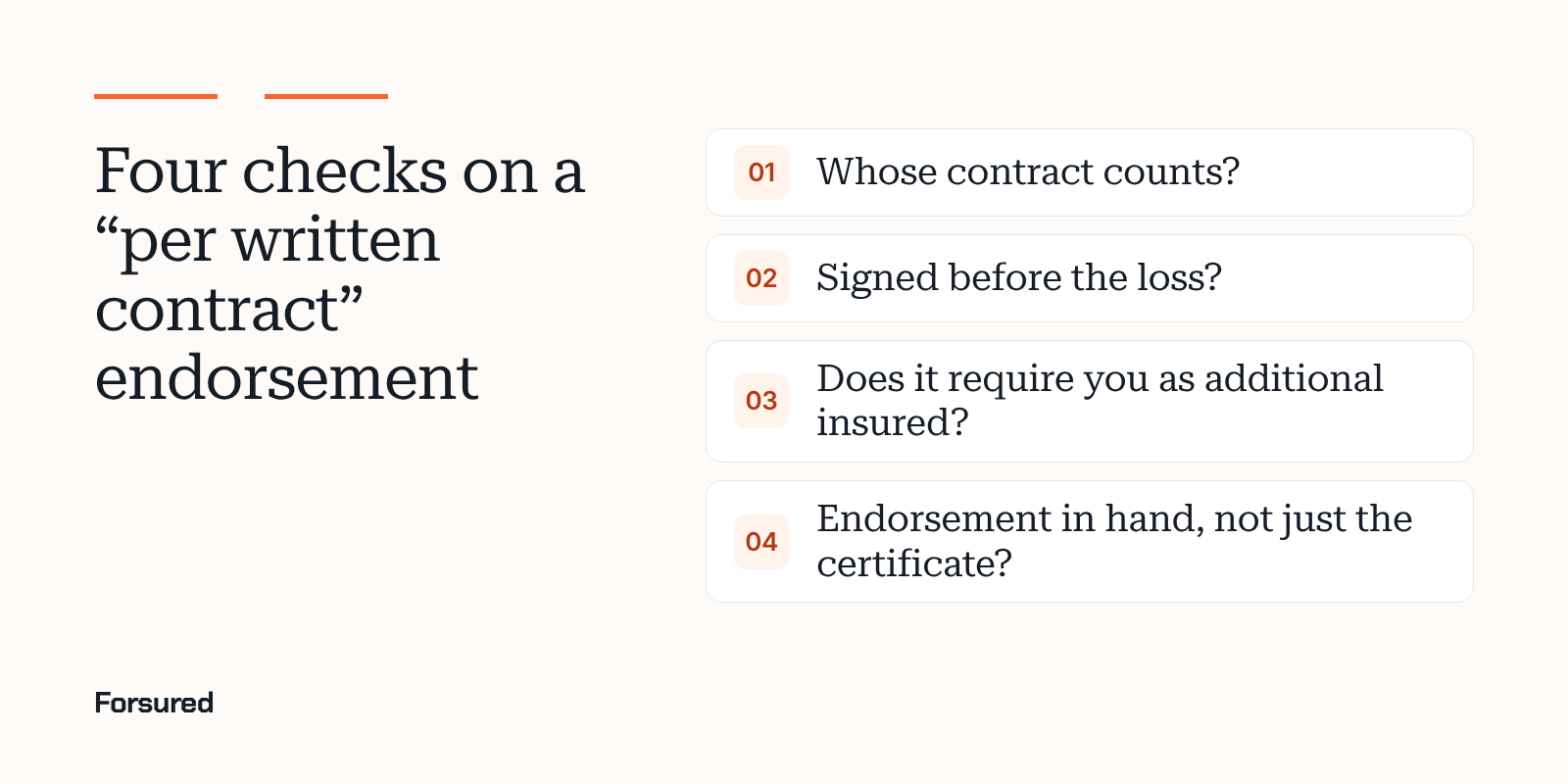
"Per written contract" means the policy adds as an additional insured whoever a written contract requires it to add, instead of naming each party on a schedule. It's convenient. One endorsement covers every owner and GC a contractor works for. But it only covers you if your situation fits the endorsement's exact words, and those words differ more than most people expect.
As IA Magazine put it, "There is no such thing as a blanket additional insured endorsement." There are many, and they don't all do the same thing.
Whose contract counts
The biggest question is whether the endorsement covers only parties the named insured contracted with directly.
New York's Court of Appeals answered it for one common wording in 2018. In Gilbane Building Co./TDX Construction Corp. v. St. Paul Fire and Marine Insurance Co., a construction manager on a Manhattan hospital project required each prime contractor to name it as an additional insured. One prime contractor's policy covered any party "with whom you have agreed to add as an additional insured by written contract." The construction manager had no contract of its own with that prime contractor. The court ruled 5-2 that "with" meant the written contract had to be with the additional insured, so the construction manager wasn't covered.
Other wording reaches further. IA Magazine notes that ISO's CG 20 33 requires privity of contract, while CG 20 38 can extend status to parties the contract requires, further up the chain. Courts in other states have split on similar language, IRMI reports, so the same words can mean different things in different places.
When it was signed, and what it says
Wording that requires a written agreement can raise more questions:
- Is it in writing? Some courts have accepted letters and other written agreements that weren't formal contracts. Others read the requirement strictly.
- Was it signed in time? Some endorsements require the agreement to be executed before the loss. IRMI notes courts apply that strictly.
- Does it actually require additional insured status? A contract with a blank or vague insurance section can leave you off the policy.
These fights are still live. In a lawsuit filed in federal court in New York and reported by Insurance Business in July, Berkley alleges Trisura refused to defend a project owner under an endorsement whose schedule read "Per Written Contract." Part of the dispute, as reported, is whether a purchase order's insurance exhibit counts as a written contract. The allegations haven't been decided.
What to check on a contractor COI
- Get the endorsement, not just the certificate. As Jones Day noted, additional insured status is created only by an endorsement the insurer issues.
- Read the wording. Look for "with whom," "such person or organization," and any execution or timing requirement.
- Check it covers every party your project requirements name, including owners and others who don't contract with that contractor directly.
- Keep the signed contract, with its insurance requirements, on file next to the endorsement.
- Recheck at renewal, when forms can change.
A blanket endorsement is only as good as the contract behind it. Forsured checks each contractor COI and its endorsements against the coverage a project actually requires, for the life of the job.
Get new posts by email.
New posts on contractor COIs and project requirements, plus the coverage gaps we're seeing on real projects. Short and plain.
You're on the list. Thanks for reading.
No spam. Unsubscribe from any email.
Common questions
What is a blanket additional insured endorsement?
An endorsement that grants additional insured status to any party a written contract requires, instead of listing each party by name. The exact wording varies by form and carrier, so two "blanket" endorsements can cover very different parties.
Does a per written contract endorsement cover an owner or GC with no direct contract with the insured?
It depends on the wording. In Gilbane Building Co./TDX Construction Corp. v. St. Paul Fire and Marine (2018), New York's Court of Appeals held that an endorsement covering parties "with whom you have agreed" by written contract required a direct contract between the named insured and the additional insured. Other forms, such as ISO's CG 20 38, extend status to parties further up the contract chain.
Is a certificate of insurance enough to prove additional insured status?
No. A certificate summarizes coverage. Additional insured status comes from an endorsement issued by the insurer, and for blanket wording, from a written contract that meets the endorsement's terms.
Sources
- Don't Sleep on This: New York High Court Addresses Scope of "Blanket" Additional Insured Endorsements, Jones Day, Apr 2018
- Making Your Bed: "Blanket" Additional Insured Endorsements and the Underlying Agreement, IRMI, Dec 1, 2014
- COI Requests: Is There a Blanket Additional Insured Endorsement?, IA Magazine, Oct 12, 2018
- Berkley's lawsuit accuses Trisura of refusing a project owner's defense, Insurance Business, Jul 1, 2026
We link to the original reporting and research behind every post. Spotted something we got wrong? Write to hello@forsured.ai and we'll fix it.