Blog / COI basics
COI basicsDoes additional insured status cover you after the job is done?
The standard additional insured endorsement covers the work while it's happening. Claims about finished work need a second form, and it's the one most often missing.
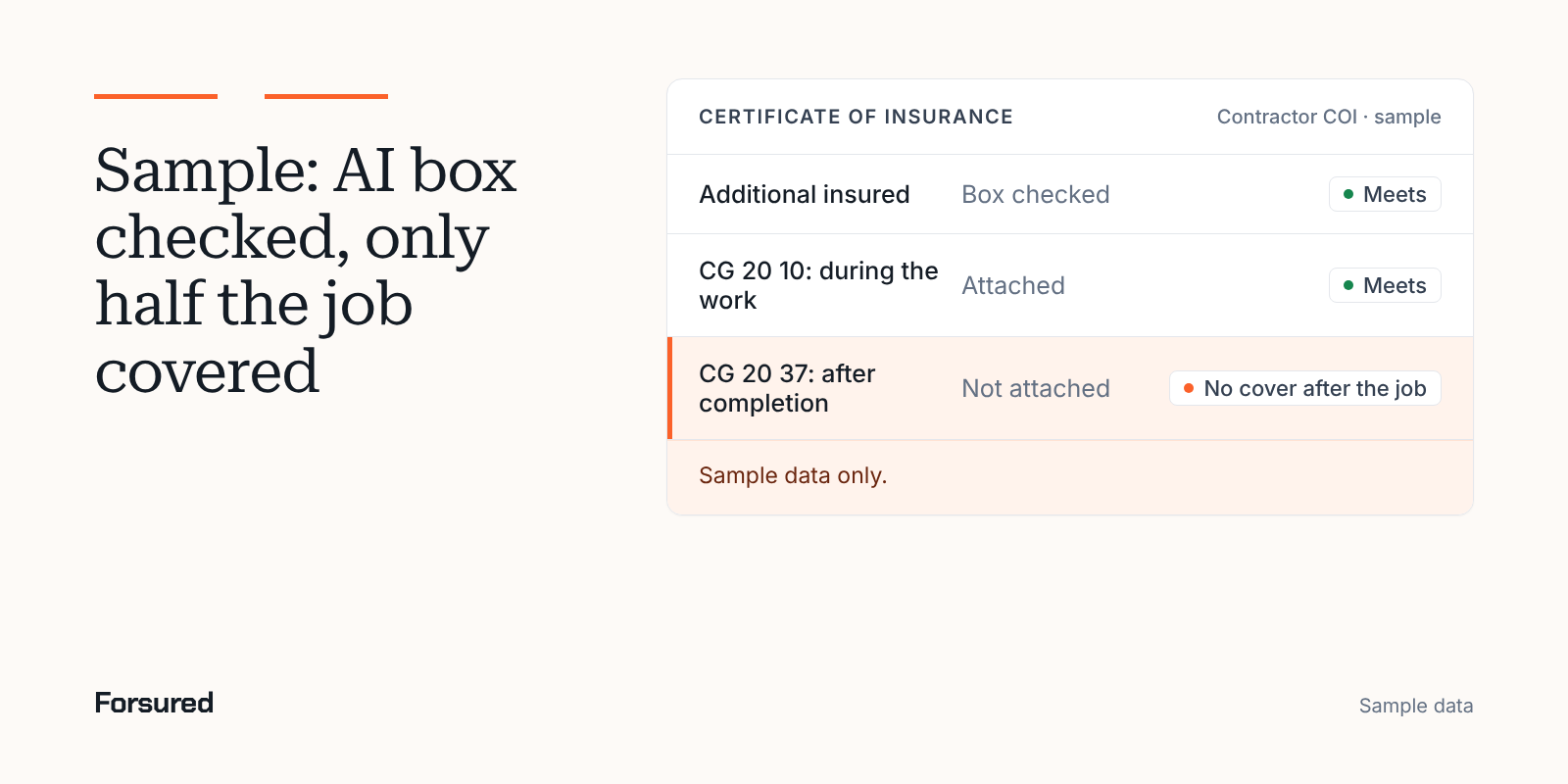
Not with the standard form alone. The ISO endorsement most contractors use to add you as an additional insured, CG 20 10, has covered only the contractor's ongoing operations since 1993. Once the work is finished, that endorsement stops responding. Coverage for finished work takes a second endorsement, CG 20 37.
Why the standard form stops at completion
The original 1985 edition, CG 20 10 11 85, covered liability arising out of the contractor's "your work," and that included both ongoing and completed operations. Construction Executive explains that ISO's October 1993 edition changed the wording to "liability arising out of your ongoing operations," which "effectively eliminated additional insured status for completed operations."
Insurance Journal put it plainly: "'Ongoing operations' does not include completed operations."
IRMI defines completed operations as work that "has been completed as called for in a contract," work finished at one jobsite of a multi-site contract, or work "that has been put to its intended use." In other words, a lot of the claims a GC or owner worries about. A roof leaks after turnover, or someone is hurt by a finished stair. Those arrive after the CG 20 10 stops covering you.
Where CG 20 37 comes in
ISO released CG 20 37 in October 2001. Construction Executive says the form's "sole purpose" was "to bring back the ability to add an additional insured to the completed operations coverage." Insurance Journal adds that it "does not provide coverage for ongoing operations."
So the two forms split the job in time:
| Endorsement | Covers you for | Doesn't cover |
|---|---|---|
| CG 20 10 (since 1993) | The contractor's ongoing operations | Completed operations |
| CG 20 37 (since 2001) | The contractor's completed operations | Ongoing operations |
The April 2013 editions of both forms added limits of their own. Coverage applies only "to the extent permitted by law," won't be "broader than that which you are required by the contract or agreement to provide," and is capped at the lesser of the contract's required amount or the policy limits.
What to check on a contractor COI
- Confirm your project requirements call for additional insured status for both ongoing and completed operations, and for how long after completion.
- Ask for both endorsements behind the checked AI box. Note each form number and edition.
- Check that the edition's limits fit your contract, especially the April 2013 language tying coverage to what the contract requires.
- Keep collecting certificates after turnover for as long as completed operations coverage must last.
Forsured checks each contractor COI against your project requirements, including the endorsement forms behind the AI box, for the life of the job.
Get new posts by email.
New posts on contractor COIs and project requirements, plus the coverage gaps we're seeing on real projects. Short and plain.
You're on the list. Thanks for reading.
No spam. Unsubscribe from any email.
About Forsured
Forsured is construction insurance compliance software for general contractors and the brokers who insure their trade contractors. You set each project's insurance requirements once. Forsured reads every contractor COI and endorsement against them, flags each gap with the reason, and keeps checking through renewals until the job is done.
- Project requirements with exceptions, not one template for every job
- Endorsement review (additional insured, waiver of subrogation, primary and noncontributory), not just the certificate
- A shared workspace where the contractor's broker sees exactly what's missing
- A person on your team approves every result, with a full review history
“What stood out to us is that Forsured doesn't just organize the paperwork. It helps us understand what meets the project requirements, what needs attention, and what needs to happen next. That clarity across the GC, subcontractor, and broker is where we see the real value.”
Send us one project's requirements and a contractor COI or two. We'll show you every gap we find, free.
Common questions
What's the difference between CG 20 10 and CG 20 37?
CG 20 10 adds you as an additional insured for liability from the contractor's ongoing operations, while the work is underway. CG 20 37 adds you for the contractor's completed operations, after the work is finished. Since 1993, neither covers both, so contracts that need both periods need both forms.
What counts as completed operations?
IRMI defines it as work that has been completed as called for in the contract, work completed at one jobsite of a multi-site contract, or work that has been put to its intended use.
Are newer editions of these forms narrower?
The April 2013 editions of both forms added limits. Coverage applies only to the extent permitted by law, won't be broader than the contract requires, and is capped at the lesser of the contract's required amount or the policy limits. Note the edition on every endorsement you receive.
Sources
- Additional Insured Endorsements in Construction, Insurance Journal, Jun 15, 2015
- The Right Endorsement: Additional Insureds, Construction Executive, Sep 20, 2018
- Completed operations (definition), IRMI
We link to the original reporting and research behind every post. This post is general information, not legal or insurance advice: Forsured is a software company, not a law firm or a licensed insurance agency, so confirm anything you'll rely on with your broker or attorney. Spotted something we got wrong? Write to hello@forsured.ai and we'll fix it.